

Black Hole Collisions May Finally Resolve the Hubble Tension
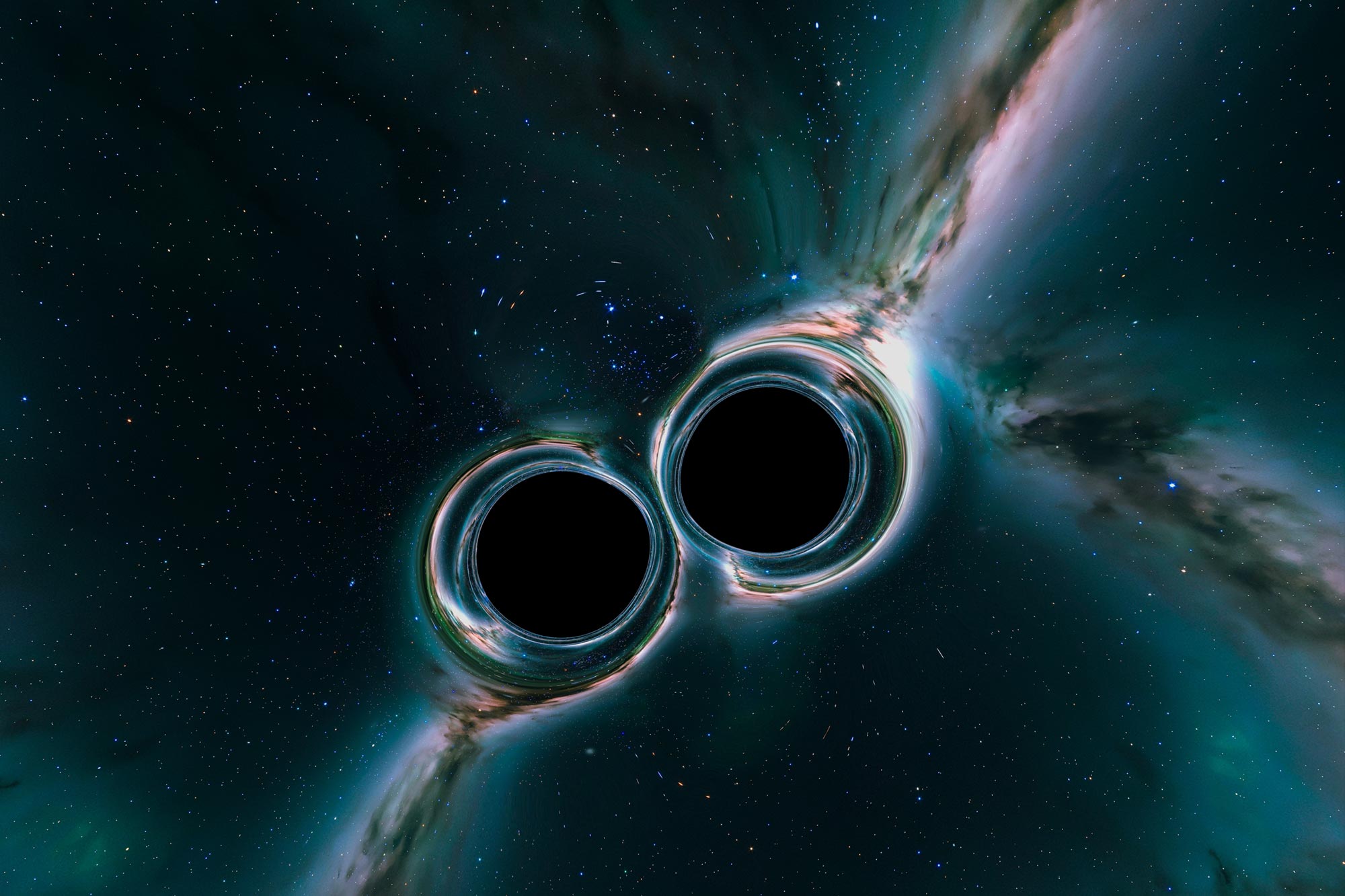
A subtle gravitational-wave “hum” from merging black holes may help settle the cosmic fight over how fast the universe is expanding.
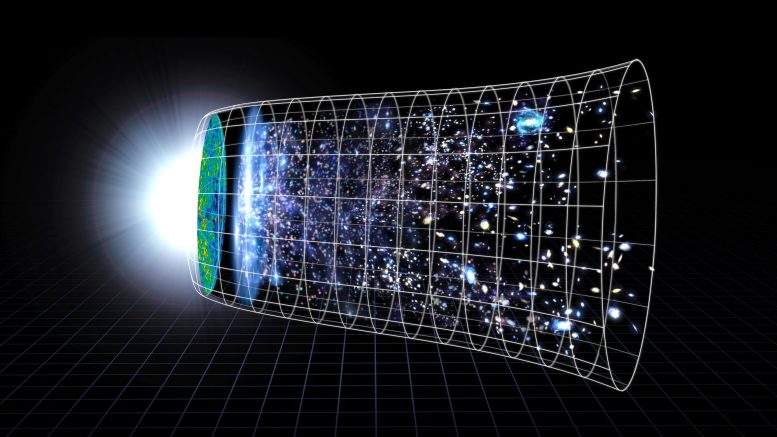
Astronomers have understood for many decades that the universe is expanding. To calculate how quickly it is stretching today, researchers measure a value called the Hubble constant. Different techniques are used to determine this number, and because they rely on the same underlying physical laws, they should agree. Instead, measurements based on observations of the early universe do not match those based on the more recent universe. This discrepancy is known as the Hubble tension, and it remains one of the most important unanswered questions in cosmology.
A team of astrophysicists and cosmologists from The Grainger College of Engineering at the University of Illinois Urbana-Champaign and the University of Chicago has now introduced a new way to estimate the Hubble constant using gravitational waves, which are tiny ripples in spacetime. Their approach improves the precision of earlier gravitational wave techniques. As detectors become more sensitive in the coming years, this strategy could lead to even tighter measurements and help clarify the source of the Hubble tension.
Illinois Physics Professor Nicolás Yunes said, “This result is very significant—it’s important to obtain an independent measurement of the Hubble constant to resolve the current Hubble tension. Our method is an innovative way to enhance the accuracy of Hubble constant inferences using gravitational waves.” Yunes is the founding director of the Illinois Center for Advanced Studies of the Universe (ICASU) on the Urbana campus.
Daniel Holz, UChicago Professor of Physics and of Astronomy & Astrophysics and a co-author of the study, added, “It’s not every day that you come up with an entirely new tool for cosmology. We show that by using the background gravitational-wave hum from merging black holes in distant galaxies, we can learn about the age and composition of the universe. This is an exciting and completely new direction, and we look forward to applying our methods to future datasets to help constrain the Hubble constant, as well as other key cosmological quantities.”
The research team also includes Illinois physics graduate student Bryce Cousins, an NSF Graduate Research Fellow and lead author of the study; Illinois physics graduate student Kristen Schumacher, an NSF Graduate Research Fellow; Illinois physics postdoctoral research associate Ka-wai Adrian Chung; and University of Chicago postdoctoral researchers Colm Talbot and Thomas Callister, both Kavli Institute for Cosmological Physics Postdoctoral Fellows. The paper has been accepted for publication in Physical Review Letters and will appear in the March 11 issue.
How Scientists Measure Cosmic Expansion
Since the early twentieth century, efforts to measure the universe’s expansion have followed two main paths: methods based on electromagnetic observations and methods based on gravitational waves. One widely used electromagnetic approach relies on “standard candles,” such as supernovae, which are bright stellar explosions. Because scientists understand how luminous these explosions truly are, they can determine both their distance from Earth and how quickly they are moving away. Together, those measurements reveal the expansion rate of the universe.
The discovery of gravitational waves opened a second route. These waves are produced when extremely dense objects, including black holes, collide. The ripples spread outward at the speed of light, similar to waves moving across water after a stone is dropped in. On Earth, the LIGO-Virgo-KAGRA (LVK) Collaboration, a global effort with more than 2,000 members, operates the instruments that detect these signals.
Gravitational waves can also provide distance measurements through what is known as the standard siren method. However, determining how fast the source is receding due to cosmic expansion is more challenging. To measure that motion, astronomers usually need to detect light from the merger or identify the galaxy where it occurred.
If all techniques were perfectly aligned, they would produce the same Hubble constant. The fact that they do not suggests something may be missing from current models. Possible explanations include early dark energy, a proposed influence that would have altered the expansion rate in the young universe; interactions between dark matter, which makes up most of the universe’s matter, and neutrinos; or changes in how dark energy evolves over time.
The Gravitational Wave Background and the Stochastic Siren Method
In the new research, Yunes, Cousins, and their colleagues propose a different strategy. Instead of focusing only on black hole mergers that detectors can clearly identify, they analyze the combined signal from many distant collisions that are too faint to be individually observed. Together, these unresolved events form what is called the gravitational-wave background.
“Because we are observing individual black hole collisions, we can determine the rates of those collisions happening across the universe. Based on those rates, we expect there to be a lot more events that we can’t observe, which is called the gravitational-wave background,” explains Cousins.
The researchers show that if the Hubble constant were smaller, the observable universe would encompass less total volume. In that case, black hole mergers would be packed into a smaller region of space, increasing the overall strength of the gravitational-wave background. If that stronger background is not detected, it effectively rules out slower expansion rates.
They refer to this approach as the stochastic siren method, reflecting the random nature of the mergers that contribute to the background signal.
Using existing LVK data, the team demonstrated that even without directly detecting the gravitational-wave background, they could place limits on very slow expansion scenarios. When they combined this method with measurements from individual black hole mergers, they achieved a more precise estimate of the Hubble constant. The resulting value lies within the region associated with the Hubble tension, showing that the method can meaningfully refine cosmological measurements.
As gravitational wave observatories continue to improve, this technique is expected to become more powerful. Scientists anticipate that the gravitational-wave background could be detected within about six years. Until then, increasingly strict upper limits on the background signal will continue narrowing the range of possible Hubble constant values.
“This should pave the way for applying this method in the future as we continue to increase the sensitivity, better constrain the gravitational-wave background, and maybe even detect it,” says Cousins. “By including that information, we expect to get better cosmological results and be closer to resolving the Hubble tension.”
Reference: “Stochastic Siren: Astrophysical gravitational-wave background measurements of the Hubble constant” by Bryce Cousins and Kristen Schumacher and Adrian Ka-Wai Chung and Colm Talbot and Thomas Callister and Daniel E. Holz and Nicolás Yunes, Accepted, Physical Review Letters.
DOI: 10.1103/4lzh-bm7y
The analysis was carried out using the Illinois Campus Cluster, operated by the Illinois Campus Cluster Program in partnership with the National Center for Supercomputing Applications.
Funding was provided by the NSF Graduate Research Fellowship Program under Grant No. DGE 21-46756 and Grant No. DGE–1746047 and the NSF under award PHY-2207650, PHY-2207650, and PHY2110507. Additional support came from the Simons Foundation through Award No. 896696 and NASA through Grant No. 80NSSC22K0806. Support was also received from the Eric and Wendy Schmidt AI in Science Postdoctoral Fellowship and the Kavli Institute for Cosmological Physics through an endowment from the Kavli Foundation and its founder Fred Kavli. The findings presented are those of the researchers and not necessarily those of the funding agencies.
Never miss a breakthrough: Join the SciTechDaily newsletter.
Follow us on Google and Google News.
Source link
